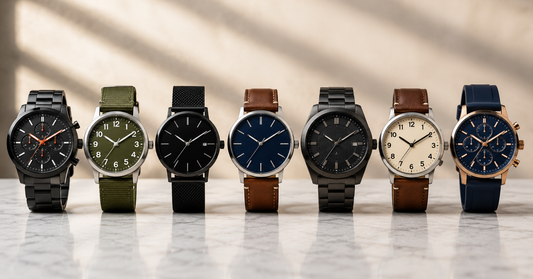
Automatic vs Quartz Watches: Which Watch Movement Fits Your Needs Best
If you have ever bought a wristwatch in your life, you are probably familiar with the ambiguous terms used in this industry. You are likely to come across terms like automatic and quartz watches, for example. While both offer their own pros and cons, when selecting a watch, you always need to think about your own criteria for accuracy and reliability of the device you are going to buy.
This comparison between automatic vs quartz watches brings forward the pros and cons of each movement and makes it easy for you to decide which type aligns best with your needs.
Quartz Vs Automatic Watches: How Do They Work?
The real difference in automatic vs quartz watches is that in a quartz watch, the hands work by sending a minute current through the crystals from the battery that vibrates 32,768 times a second. Then the circuit counts these vibrations and moves the second hand once a second. You can hear it tick because of the vibrations.
Automatic watches’ movement is driven by mechanical forces. The mainspring is the part that makes the movement possible because it stores the necessary amount of energy for driving the clock. Secondly, the balance wheel is the component with its oscillation that serves to establish the regular manner of the movement. Finally, the rotor that drives the automatic movement of your watch serves to wind the mainspring with the assistance of the arm's movement.
Precision In Automatic Vs Quartz Watches
Quartz timepieces utilize a quartz crystal as a “timing base,” effectively converting 32,768 oscillations into 1 second by generating a pulse to a “stepping motor” that advances the second hand by one step each second. But when you see automatic vs quartz watches side by side, in an automatic timepiece, a system of gears, levers, and a delicate hairspring work together to create an escapement mechanism that releases the energy from the wound mainspring at a consistent rate of 6 or 8 ticks per second.
An ordinary quartz watch usually provides an accuracy of 15 to 20 seconds a month in actual wear, which is about half a second a day. Well-calibrated and oiled automatic watches provide an accuracy of -20 seconds to +40 seconds each day for the normal movement and -10 seconds to +30 seconds for the high-beat movement.
Maintenance Frequency
Quartz requires a battery replacement every two to three years. Even though the regular replacement is cheap, over a few years the cost can add up. That is the complete maintenance timetable.
Automatic watches require a complete service; the watch is disassembled, cleaned, lubricated, reassembled, and adjusted. Service costs more than a replacement battery over five to seven years. This way, the timepiece can last your entire lifetime and goes on to outlive your child.
Automatic Vs Quartz Watches: For Everyday Use
If you wear an automatic watch, it needs to be worn or wound regularly, but if worn daily, it will have few issues. Gradually, it starts to run slower as oil dries and thickens. Remove it for a weekend, and it will cease, and you will set the time and the date again. This is not a defect. It’s the cost of entry for a timepiece that is actively functioning on your wrist.
Wear a quartz watch, and it will run until its battery dies. For this, you can rotate between three watches, store one in a drawer for a year, take it out on a Tuesday; it will be functioning, and it will show the correct time. No coiling, no restarting, no ceremony.
Which Lifestyle Suits The Best Watches: Quartz Vs Automatic?
So, to further compare automatic vs quartz watches, you need to know which one suits your everyday life. Quartz is the solution if you switch between various watches, frequently move across time zones, require precise timing, prefer the slimmest design, or just want a watch that doesn't require much from you. The majority of travel watches and many sports watches are quartz for this very reason. So if you don't want to deal with frequent keeping up, this is your type of watch.
Automatic is the solution if you appreciate the concept of an object that reacts to you, that genuinely operates mechanically based on your movement. If you desire something to pass on, or the absence of a battery, chip, or software seems like a subtle, silent defiance against all that you wear on your wrist, you are best suited to an automatic watch.
Automatic Vs Quartz Watches: Detailed Comparison
|
|
Automatic watches |
Quartz watches |
|
Power reserve |
Must be kept wound to keep running |
Will run for a number of years, until the battery dies |
|
Power source |
Mainspring, which is self-winding by the wearer's movement |
Battery |
|
Price |
More expensive, especially for more complex models |
More affordable |
|
Reliability |
Needs to be worn or wound regularly, but if worn daily, will have few issues. |
Typically runs accurately until the battery dies. |
|
Shock resistance and durability |
Good casings make it shockproof, but have a lot more moving parts |
More shock-resistant, with fewer moving parts |
|
Size and weight |
Thicker, heavier |
Lighter, thinner |
Automatic Vs Quartz Watches: The Final Verdict
Automatic vs quartz watches: whichever you choose, it should have qualities that suit your requirements and beauty that pleases you. If you want a watch with very accurate timekeeping, then go for quartz; but if you want to own a watch because of its history and construction, then choose automatic.
So, visit us. We are a proud family-owned authorized retailer for some of the biggest watch brands, and all watches sold at Muradandco are authentic items sourced directly from the manufacturer. We offer both pre-owned and new watches to give you the freedom you deserve.
Tags:
Previous
Tissot Heritage Watches Explained: History, Design, and Features
Next
Bezel Watches Care Tips to Keep Your Timepiece Looking New